
The Wellness Industry’s New Obsession: Peptides
Disclaimer: This article reflects my personal experience and research and should not be considered medical advice. Always consult a qualified healthcare professional before making decisions about your health.
A few years ago, most people had never heard the word peptide outside of a skincare label.
Today, they’re everywhere.
Podcasts, wellness clinics, longevity conferences, biohacking forums, and your favorite fitness influencer’s morning routine. It feels like every week there’s a new compound being discussed as the next breakthrough for energy, recovery, metabolism, skin health, or simply feeling better as we age.
I’ve been interested in wellness long enough to recognize this pattern.
A new discovery appears. Social media picks it up. The excitement spreads faster than the research. Suddenly everyone has an opinion, and many of those opinions aren’t actually based on the science.
So when peptides started showing up everywhere, I did what I always try to do.
I got curious, I read the studies.
And eventually, I tried two of them myself.
My interest wasn’t about finding a shortcut.
It was about understanding whether there were tools that could support healthy aging, recovery, and overall wellbeing alongside the habits I already prioritize.
Like many people interested in wellness, I wanted to know whether the excitement around peptides was grounded in real science or simply another trend wrapped in good marketing.
This is what I’ve learned so far.
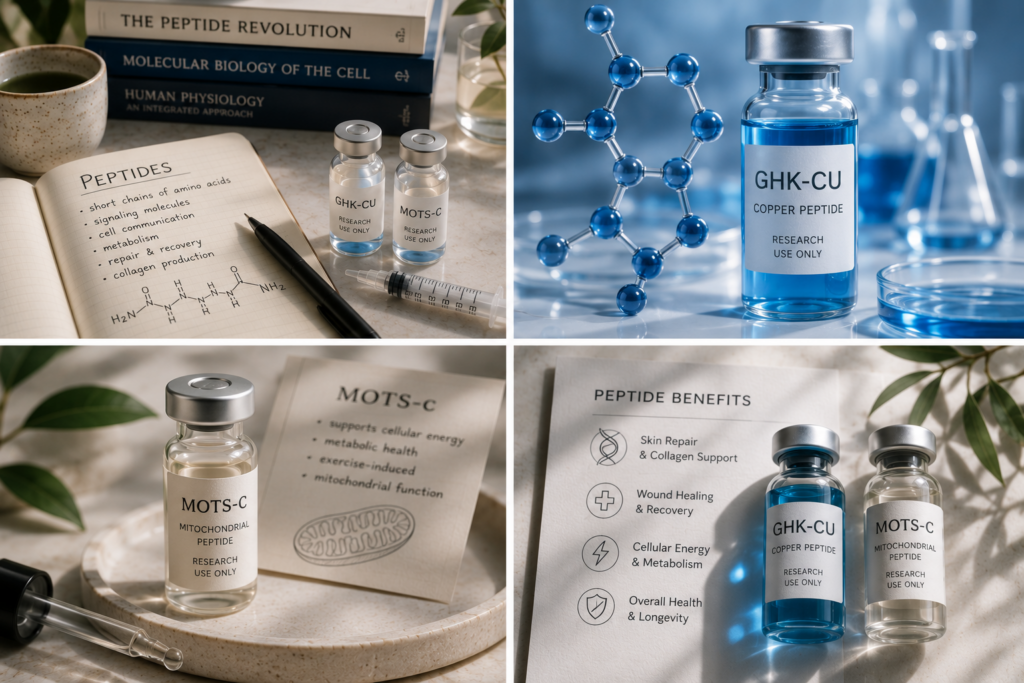
What Peptides Actually Are
At their simplest, peptides are short chains of amino acids, the building blocks that make up proteins.
Your body already produces countless peptides naturally. They act as biological messengers, helping regulate everything from healing and inflammation to metabolism and cellular function.
What researchers are now exploring is whether certain peptides, introduced externally, can support or restore some of these biological processes.
That’s where things get interesting.
And complicated.
Because the science is genuinely evolving, while wellness culture often moves much faster than peer-reviewed research.
Why Everyone Is Talking About Them Now
I think peptides arrived at the perfect moment.
The wellness conversation has shifted dramatically over the last few years.
People aren’t only asking how to live longer anymore. They’re asking how to stay energetic, mobile, strong, and mentally sharp while they do it.
They want quality of life, and they want healthy aging.
They want to feel good in their bodies for as long as possible.
Peptides have become part of that conversation because some of the early research around metabolism, recovery, cellular repair, and skin health is genuinely promising.
But as with every wellness trend that reaches social media, separating the signal from the noise isn’t always easy.
The Two Peptides I’ve Tried
Before I go any further, I want to be clear about something.
I’m not a doctor.
I’m not a biochemist.
And I’m definitely not a longevity expert.
I’m simply someone who enjoys learning about health, reads a lot, and pays close attention to how my body responds to different things.
So far, I’ve only experimented with two peptides: GHK-Cu and MOTS-c.
GHK-Cu
GHK-Cu is a naturally occurring copper peptide with a research history that goes back to 1973, when it was first isolated from human plasma. That’s longer than most compounds currently trending in wellness circles, and it’s one of the reasons I trusted it enough to explore further.
Early research showed it stimulates the synthesis of collagen, elastin, and glycosaminoglycans in skin, accelerates wound healing, and restores the function of damaged fibroblasts. More recent studies have taken that further. Researchers have found that GHK-Cu appears to influence the expression of at least 4,000 genes in the human genome, essentially shifting DNA expression back toward a healthier state.
That’s not marketing copy. That’s published, peer-reviewed research.
The strongest evidence supports its role in skin repair and wound healing. Emerging research points to broader regenerative effects, but those remain under active investigation. Much of the enthusiasm surrounding it is grounded in real biological mechanisms, even if clinical validation is still evolving.
Personally, I was more interested in the tissue repair angle than the cosmetic side.
As someone who moves her body almost every day, whether through yoga, long walks, or simply staying active, supporting the body’s natural repair processes felt more appealing than chasing a younger face.
My experience with it has been gradual and not dramatic.
If I’m honest, that’s probably why I trust it.
Wellness culture loves overnight transformations and dramatic before-and-afters, but most of the habits and practices that have genuinely improved my life worked much more quietly. I only noticed their impact when I looked back months later.
MOTS-c
MOTS-c is newer and, in many ways, the peptide I find most fascinating.
Unlike most proteins, which are encoded by nuclear DNA, MOTS-c originates within the mitochondria, giving it a unique role in cellular communication and metabolic regulation.
Researchers are studying its potential role in cellular energy production and metabolic health, and the more I read, the more interesting it gets. Specifically, MOTS-c interacts with AMPK, Akt, and SIRT1 to improve lipid oxidation, glucose metabolism, and insulin sensitivity, which makes it a genuinely interesting area of study for long-term metabolic health.
What caught my attention most, though, was its relationship with movement.
Research shows that exercise naturally induces MOTS-c expression in skeletal muscle and in circulation, meaning the body actually produces more of it when we move.
Yoga has been part of my life for years, and movement is one of the few things that consistently helps me feel grounded, energized, and mentally clear. The idea that exercise and this peptide are connected at a cellular level felt worth exploring.
One thing that’s important to mention: MOTS-c was added to the World Anti-Doping Agency’s banned list in 2024. If you’re a competitive athlete in a sport governed by WADA regulations, that’s something you should absolutely research before considering it.
What the Science Is — and Isn’t — Saying
This is where I think it’s important to slow down.
The research on both GHK-Cu and MOTS-c is real and ongoing.
But a meaningful portion of that research is still based on animal models or early-stage human studies.
That’s not a criticism.
It’s simply where the science currently stands.
Research on the metabolic role of MOTS-c in humans specifically remains limited.
The gap between “this showed promise in a laboratory setting” and “this is proven to work consistently in humans” can be significant.
That doesn’t make these compounds ineffective.
It simply means we’re still learning.
And anyone presenting peptide research as completely settled science is probably oversimplifying a much more nuanced picture.
Personally, I try to stay curious without becoming certain.
The more I researched peptides, the more I noticed a pattern.
The conversation often focused on optimization, but rarely on the foundations that make optimization possible in the first place.
Everyone wanted to know what supplement to take, what protocol to follow, or what breakthrough might be coming next.
Very few people were talking about the habits that have been improving human health long before peptides entered the conversation.
The Part Wellness Culture Keeps Skipping
Whenever I go down a rabbit hole involving peptides, longevity protocols, supplements, or the latest health trend, I always come back to the same question:
What are the foundations?
Because no peptide, supplement, or protocol replaces the things that have the strongest evidence behind them.
Sleep, Movement, Stress management, Time outdoors, Real food, Meaningful relationships.
The healthiest people I know aren’t running complicated biohacking protocols.
They walk, They sleep, They move their bodies, They spend time with people they love.
They do the boring things consistently.
Wellness culture often makes optimal health sound like a complicated puzzle that can only be solved with the latest discovery.
But most of us haven’t mastered the basics yet.
Peptides, at their best, are tools that may support a body that’s already being taken care of.
They are not a shortcut around the foundations.
Are Peptides Worth It?
At this stage, I think that’s the wrong question.
A better question might be: are peptides worth exploring?
For me, the answer is yes.
Not because I expect miracles, and not because I believe they can replace the fundamentals of health.
They’re interesting because they represent a growing area of research that may help us better understand how the body repairs, adapts, and ages.
Whether peptides eventually become a lasting part of my wellness routine is something only time, research, and personal experience will answer.
For now, I see them as tools worth learning about, not solutions worth worshipping.
Where I Am With All of This
I don’t have a definitive verdict on either peptide I’ve tried, but I have observations, and I have questions. I have experiences that may or may not be connected to the peptides themselves.
That’s the honest reality of self-experimentation outside of a controlled clinical trial.
What I do know is that this field is worth paying attention to.
The research behind GHK-Cu has decades of history behind it.
The science surrounding MOTS-c is much newer but genuinely intriguing, particularly when it comes to metabolic health and physical activity.
For now, I don’t see peptides as a miracle solution or the future of wellness.
I see them as an interesting area of research.
One more tool that may have a place alongside the things we already know matter: sleep, movement, nutrition, stress management, and meaningful human connection.
I’ll keep reading the studies, paying attention to my own experience.
And I’ll keep asking whether what I’m reading is the research itself or someone’s interpretation of it designed to sell me something.
Because that’s a question worth asking about almost everything in wellness.
And perhaps that’s the biggest lesson peptides have taught me so far:
Stay curious. open-minded, but don’t stop thinking critically.

Sources & Further Reading
If you want to go deeper, here is where I would actually start. I have tried to link primary research rather than wellness blogs that are just summarising other wellness blogs.
On GHK-Cu
Pickart, L. & Margolina, A. (2018). Regenerative and Protective Actions of the GHK-Cu Peptide in the Light of the New Gene Data. International Journal of Molecular Sciences, 19(7), 1987. This is the foundational paper on GHK-Cu’s influence on gene expression. Available on PubMed and ResearchGate.
On MOTS-c
Reynolds, J.C. et al. (2021). MOTS-c is an exercise-induced mitochondrial-encoded regulator of age-dependent physical decline and muscle homeostasis. Nature Communications, 12, 470. This paper provides evidence that exercise induces endogenous MOTS-c expression in skeletal muscle and in circulation in humans. Available on Nature.com and PubMed. Lemon8
Wan, Z. et al. (2023). Mitochondria-derived peptide MOTS-c: effects and mechanisms related to stress, metabolism and aging. Journal of Translational Medicine, 21, 36. This review covers MOTS-c’s role in energy metabolism, insulin resistance, inflammatory response, exercise, and aging-related pathologies. Available on PubMed (free full text) and Springer Nature. The Yogatique
On peptides, longevity, and healthy aging more broadly
The longevity researcher Peter Attia covers peptides, metabolic health, and aging protocols with a good balance of scientific rigour and accessibility. His book Outlive and his podcast The Drive are good entry points if you want context beyond individual compounds.
For raw research, PubMed (pubmed.ncbi.nlm.nih.gov) is free to access and where I go to read the actual studies rather than third-party summaries of them.
As with any emerging area of health and wellness, the science continues to evolve, and what we know today may look different in five years.
That is exactly why staying curious matters.
Are you exploring peptides or simply curious about them? I’d love to hear your thoughts, experiences, or questions in the comments below.